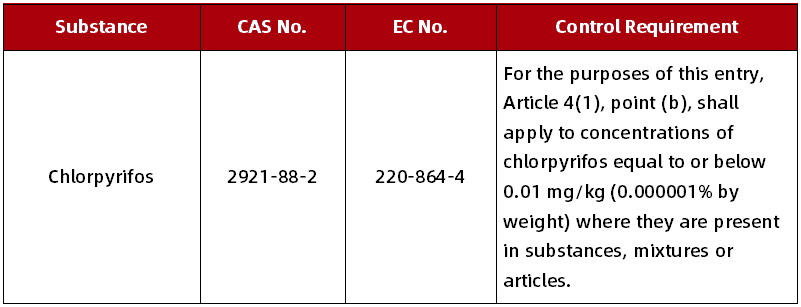
On 30 June 2026, the European Commission adopted draft Delegated Regulation C(2026) 4428 final, proposing to amend Regulation (EU) 2019/1021 on persistent organic pollutants (POPs) by adding chlorpyrifos to Part A of Annex I. The document is still at the draft stage and must complete the EU delegated regulation procedure. Once published in the Official Journal of the European Union, the Regulation will enter into force on the 20th day following its publication and will be directly applicable in all EU Member States.
Regulatory Background
Chlorpyrifos is an organophosphate insecticide formerly used for agricultural pest control. At the 12th meeting of the Conference of the Parties to the Stockholm Convention in 2025, chlorpyrifos was decided to be listed in Annex A to the Convention. The EU draft aims to transpose that decision into Annex I to Regulation (EU) 2019/1021. According to the draft, chlorpyrifos is currently not approved in the EU for use as an active substance in plant protection products or biocidal products. It is therefore proposed to be listed in Annex I to the EU POPs Regulation without specific exemptions.
Key Substance Information
Points for Enterprises
Companies concerned may first review whether chlorpyrifos may be involved in products exported to the EU, raw materials, additives, recycled materials and supply chain documentation, and pay attention to the risk of unintentional trace contamination in substances, mixtures or articles.
As the document remains at the draft stage, companies are advised to monitor the final text published in the Official Journal of the European Union and its date of entry into force, and update supplier declarations, test reports and technical documents accordingly.
CTT Reminder
The POPs Regulation mainly targets substances with persistence, bioaccumulation, potential for long-range environmental transport, and potential risks to human health or the environment. Companies may conduct substance risk screening and supply chain compliance management in advance based on product type, material composition and target export markets.
CTT can provide regulatory consulting, product testing, supply chain risk screening and compliance training based on relevant regulations and product hazardous substance control requirements. Please contact us for more information or testing support.

 Safety/EMC/Wireless
 Inspection & Audit
 Testing/Compliance/Consultation
(USA & CANADA)
Testing/Compliance/Consultation
(USA & CANADA)